

Before you choose a coin for a long/short trade, check what it costs to hold. A strong price bet can pay less than a smaller one after funding and trading costs.
Across our strategies, the daily choice weighs price rank and funding together. You get that decision handled for you, instead of checking each long, each short and each bill by hand. Funding helps make the choice; it does not replace the ranking.
Who pays funding?
A perpetual future has no expiry date. To help keep its price near the coin’s cash-market price, traders on one side pay traders on the other at set times. When the funding rate is positive, longs usually pay shorts; when it is negative, shorts usually pay longs. The rate and payment times depend on the contract and exchange, and the rate can change.
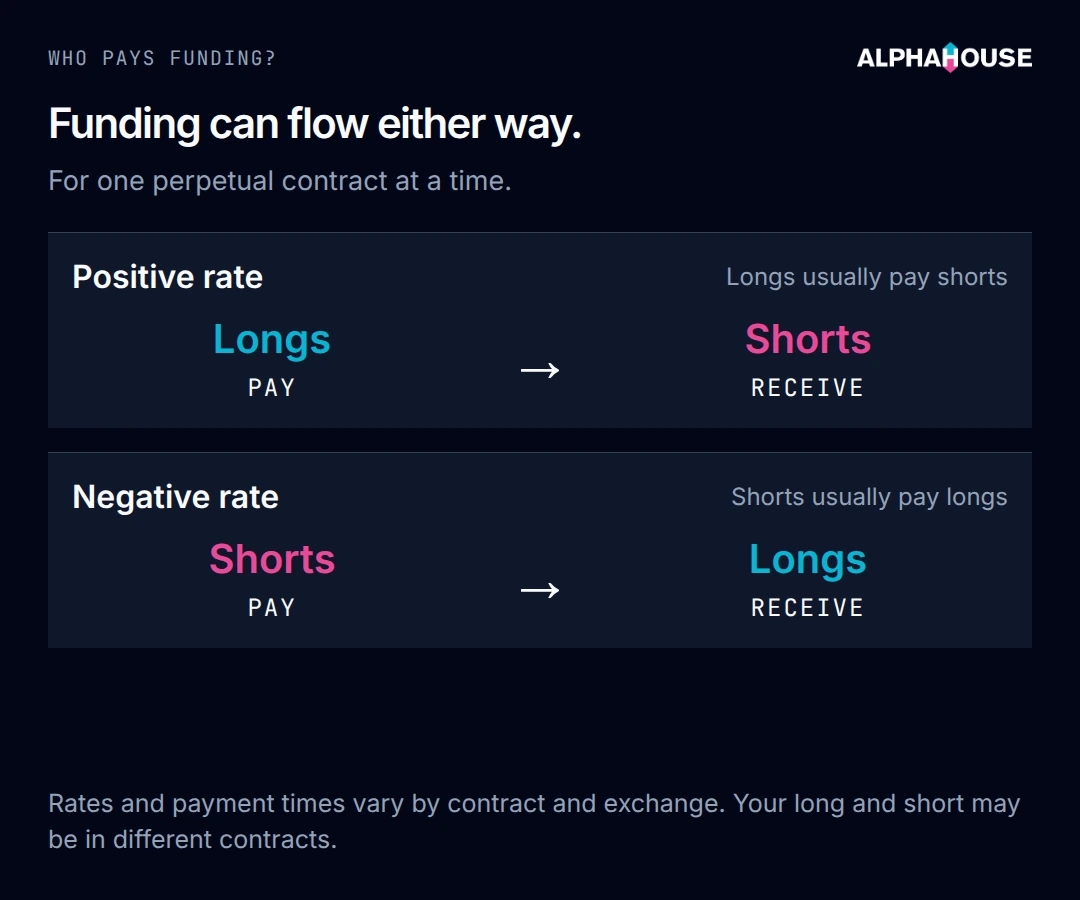
Our long and short can be in different contracts. One side may receive funding while the other pays it, so equal starting dollars do not mean the payments cancel. And we still pay fees to trade, plus slippage if an order fills at a worse price than planned. Add up the whole trade before you favor a single tempting rate.
Two shorts, the same buy
Here is a made-up comparison, not our ranking formula, an actual position, a forecast or a result from an account. Each choice pairs a $10,000 short with the same $10,000 long for the same example holding window. We assume one funding payment, rates that hold until that payment, and the fees and slippage shown. To keep the comparison simple, funding on the shared long is assumed to be $0. In a real trade, that long could pay or receive funding too.
The price spread is the long’s price change minus the short’s, applied to the equal starting dollars. The price lines below are guesses about future moves, not gains already made.
| One example holding window | Short candidate A + same long | Short candidate B + same long |
|---|---|---|
| Expected price spread | +$60 (0.60% of $10,000) | +$45 (0.45% of $10,000) |
| Funding on the short | −$20 (pay 0.20%) | +$2 (receive 0.02%) |
| Fees and slippage | −$12 | −$10 |
| Example net | +$28 | +$37 |
A leads on the expected price difference, $60 to $45. But after short funding and the cost of trading, B leads $37 to $28. The $9 gap is only as good as these assumptions. If B’s price bet misses or its funding rate flips, B may lose that lead. A could be the better choice another day.
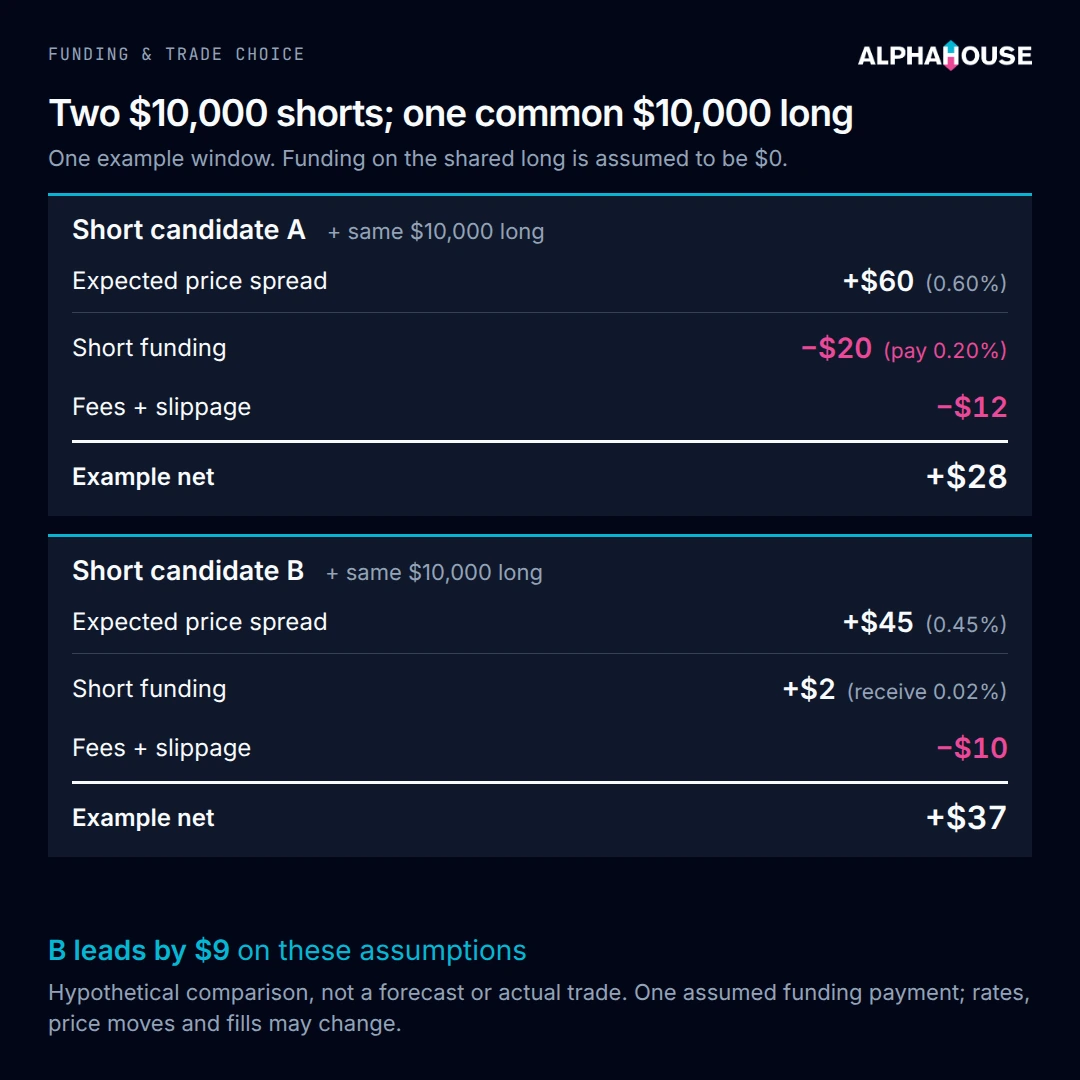
One hypothetical window. Funding on the shared long is assumed to be $0; a real long can pay or receive too. Percentages use each $10,000 starting exposure, not annual rates.
We do the daily comparison
Checking one pair is quick; keeping a full book ranked, sized and in step with your account takes more work. The aim is to make the daily choice without making you rebuild it by hand. We are not claiming an intraday switch every time a rate moves or a funding-only return boost measured apart from the strategy.
The published performance record includes modeled funding, fees and slippage, so it is more useful than a chart that ignores the cost of trading. It does not tell you how much funding decisions alone added or what your account will earn. Your exchange’s rates, fills and available contracts can differ; a perpetual can lose money or be liquidated even when it receives funding.
When you compare long/short systems, ask for the whole ledger: expected price difference, funding on each side, and trading costs. Read our performance method with that ledger in mind.